
Disruption
The truth of Oxford's lawns, uncovered.


By Sheri Hjelm
They told us that stepping on the grass was strictly prohibited. Admittedly, that didn’t make the desire any less tantalizing. “Keep off the grass” was one of the first instructions upon arriving at Exeter College of the esteemed, historic University of Oxford for summer courses. Students and visitors were strictly forbidden from luxuriating in or even setting foot upon the grass. Still, concessions were made on very special occasions, like when the King and Queen of Spain made a visit to the university for the first time in more than 30 years. That day, permission to stand on the grass was almost as exhilarating as being part of the royal visit itself, so much so that I took multiple pictures of the royal couple and of where my feet were planted as proof that both events actually happened.
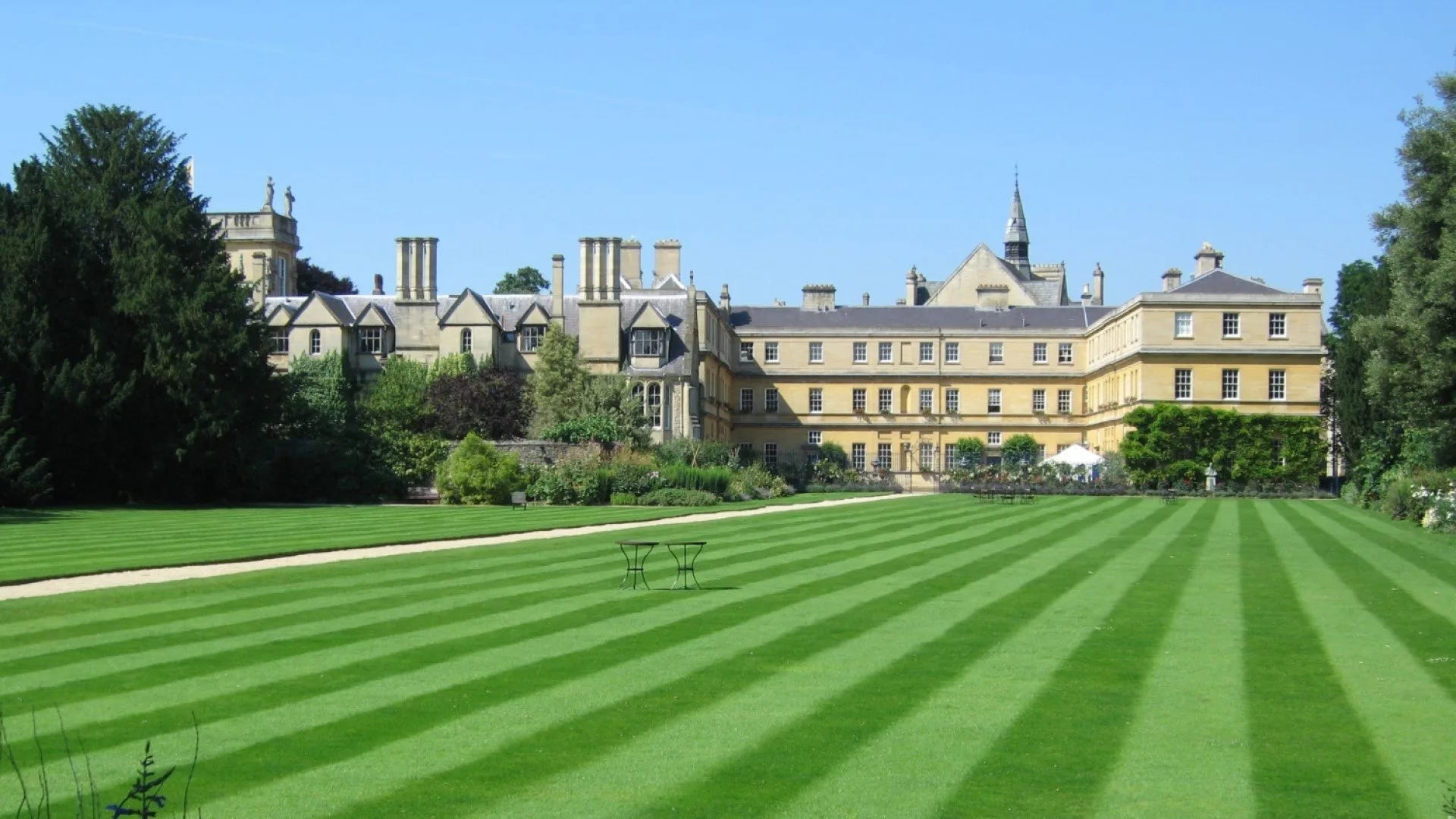
But now, as I look back through the scores of photographs from my summer as an Oxford student, I cannot find a single one of the prohibition signs. It was prohibited, though, and famously so, like a taboo that braids the experiences of current Oxford students with the likes of C.S. Lewis and J.R.R. Tolkien. Those gorgeous lawns, which raced to the less exciting stone walkway buttressing the medieval walls, were expertly manicured in luscious stripes of the most verdant greens, alternating so each chlorophyl molecule radiated the full power of the sun. An entire crew of groundskeepers, whose responsibility it was to maintain the ivy vines that crawled halfway up the courtyard walls and make that lawn so attractive, scarcely appeared, but evidence of their work was ever present in our longing to wander through the grass and disrupt that sacred space.
I’m not the only one who was entranced by the lawns in Oxford’s famous quads. In July of 1896 future President Woodrow Wilson visited Oxford and was so taken by the quads and, in particular, “what nature as well as art has done for the incomparable place that has taken us captive,” that he advocated heartedly for a similar residential college model when he presided over Princeton University. Other American and European colleges followed suit, embracing beautifully landscaped quads on their campuses, and without squinting too hard, we can see how the campus greens of Oxford, Cambridge, Princeton, Brown, Duke, among many others, likely were inspired by medieval monasteries; monks, like future undergraduates, crisscrossed those green quads as they moved about their days. In more recent history, however, the idyllic lure of the college lawn faces scrutiny: maintenance is costly, campus expansions often necessitate reappropriation of the open spaces, and responsible environmental practices are brought to question. Those lawns that were once so inviting now invite controversy. This is especially true in the case of Cambridge.
While the world was shuttering for the Covid-19 pandemic, a cadre of environmentalists turned the coveted lawns of Cambridge into a battleground. Xtinction Rebellion, a grassroots movement whose origins date back to 2018 London, gathered academics, scientists, and social justice advocates with the shared intention of disrupting and overwhelming political systems so that the need for true change might be realized. Since its beginnings, Xtinction Rebellion made social and political noise to combat dire global environmental projections, like demanding that governments tell the truth about the circumstances of the climate emergency, end the loss of biodiversity by committing to net zero emissions policies, and follow the lead of an assemblage of educated citizenry. Noble as they may be, the early missions of the organization depended on the deep-rooted belief that radical change was possible if enough ordinary people were driven to civilly disobey.
The first few campaigns at the end of 2018 were able to generate the disruption they intended, where, first, more than 1,000 activists joined in general protest outside the British parliament; the next month five bridges in central London were blocked in a day-long demonstration. All of the chaos showed the movement was taking root, and since London courts were now being inundated with activist arrests, Xtinction Rebellion was able to bring focus to the ecological crisis and create conversation. One of the characteristics of the organization is that there isn’t a centralized hierarchical structure, rather only the imperative to teach their mission in local communities, recruit participants, and then rebel; this effectively allows the movement both to exist in physical—and not only virtual—spaces, and to be less predictable with its campaigns. This issue, however, extended beyond public demonstrations and into the institutional relationships that silently sustain the fossil fuel economy. So as activists in London took to the streets, another group under the XR banner began taking aim at Cambridge and the ways the university works alongside one of the largest oilfield services companies in the world.
Schlumberger, currently rebranded as SLB, builds the technology used by corporate giants like Shell and BP to extract fossil fuels across industry. Unhappy with the quiet alliance between SLB and the University of Cambridge, who XR activists accuse of providing a pipeline of academics to perpetuate activities that worsen global ecological conditions, the activists also took issue with the fact that SLB operates a research facility in Cambridge. Xtinction Rebellion did their own research to explore the history of the alliance and discovered a network of affiliations dating back almost 50 years, and allege that SLB uses the association for social capital: to greenwash some business activities and to legitimize itself through the funding of doctoral scholarships and fellowships. So, in order to protest the alliance after more than a year of disruptive campaigns, an XR group showed up with shovels and pitchforks to excavate the beautiful green lawn, a cultural symbol of aristocratic stature of Trinity College. Much of the lawn was then deposited in front of the Barclays Bank in Cambridge to protest their participation in the funding.
It seems digging up the gorgeously manicured lawns of Trinity College claimed the dual purpose of protesting the partnership with SLB, but also by disrupting how fundamental the landscape is to the college. Students, faculty, staff, and the whole of Cambridge were left shocked with what had been historically a photogenic green lawn near Isaac Newton’s apple tree outside Trinity College. The unearthed landscape made a global statement back in 2020; several of the XR protestors were fined and the repairs to the grounds cost over £4,000, but Trinity College ultimately conceded to divest 95% of its £1.5 billion endowment fund from all fossil fuel companies. The decision was the result of many years of campaigns, which came to a head after the direct action of digging up the lawn. Here, it seems the series of disruptions proved effective. But is this a sustainable model for others to follow? Have the efforts of Cambridge’s Xtinction Rebellion been enough to create lasting change—to either other elite colleges in standing up to fossil fuel giants, or to interrupt the expectation of a return to the lawn’s former glory? XR Cambridge continues their campaigns to disrupt SLB’s endeavors, yet here we are, six years later: Trinity College’s lawn is as green and verdantly picturesque as ever.
Still, incessant extreme interference with organizations whose policies and practices overlook their environmental responsibilities isn’t the only way to speak out against ecological injustices; in the attention economy we live in, the most extreme often garners the most attention. Ellen F. Steinberg, whose stage name is Annie Sprinkle, has grown exceedingly comfortable embracing the extreme, and, well, embracing a lot of other things, too. Her story spans decades and careers, as she made her way from working in a theater to starring in more than a hundred pornographic films and stretching the limits of what her resume expected of her. Over time, she began using her performances to educate audiences on bodies and sexuality, eventually pursuing a PhD, and for the past twenty years, she has become a performance artist, writer, lecturer, social activist, and “ecosexual.”
Essentially, Sprinkle has turned her identity into an environmental activist strategy. After marrying in a domestic partnership ceremony alongside 33 other couples in San Francisco, Sprinkle and her wife, Beth Stephens, participated in 21 different wedding ceremonies around the globe. It began as a seven-year collaborative art project, and instead of marrying each other, the couple and other participants were invited to make commitments to the earth through different elements of the natural world. The weddings to coal, snow, sky, soil, sun, and the like became color-filled demonstrations of symbolic performance art, musical merriment, and occasions for community as Sprinkle, Stephens, and the other participants disrupted conventional expressions of marriage. They transformed the language of love into activism with the goal, Stephens says, “of making the environmental movement more sexy, fun, and diverse.”
Together, Sprinkle and Stephens travel internationally sharing their ideology and their manifesto, which has been translated into twelve languages. They call themselves “ecosexuals” and use their platform to commit to the earth in an effort to save it. And while the weddings and the books like Assuming the Ecosexual Position: The Earth as Lover and the cinematic productions on wildfires and social fires seem outlandish, there might be something more cerebral to consider. Sprinkle uses controversy to fuel critical thinking. She blurs the lines between sex work, art, and activism, and, as a result, disrupts our understandings of body image, feminism, and environmentalism—ideas most of us probably didn’t expect to overlap in a Venn diagram. She took something widely perceived as private and gently forced audiences to examine it from a different perspective, much in the same way that the 1970s porn star earned a doctorate degree and used it to critique the industry that made her famous. And just as she went from the object to deconstructing objectification, now Sprinkle is legitimizing herself as a social reformer who has created an artful and joyful, albeit extreme, movement to reconceive our relationship with the earth as a lover.
Using one’s body to become one with the natural world or digging up the most prestigious lawns are extreme stances in this ecological conversation, but they do point to an important question: in matters of consequence, when virality and news cycles compete for the most outrageously scintillating stories and the average person’s attention span is shrinking, how do those who are trying to fight for a respectable cause make themselves heard? How can we create meaningful disruption to errant thinking? Someone at the University of Pennsylvania had an idea.
If you’ve read this far, you are taking part in a solution right now. Here, in this focused examination, the contributors to this XFic issue are attempting to disrupt your conventional understanding of lawns and asking you to challenge yourself to consider something banal from a different viewpoint. In this experimental nonfiction journal, founded and run by journalist and instructor Jay Kirk, writers combine unique storytelling and compelling narrative techniques alongside extensive reporting and researching. From cultural analysis of horror movies and adult cartoons to investigative pieces on lawn mower injuries and pesticide, writers seek to better understand this ubiquitous image of American society. Like a prism separates a single beam of light into all of its colorful constituents, “The American Lawn Project” seeks to defamiliarize intellectuals with the traditional conception of a lawn, to disrupt so as to look anew.
Imagining your childhood home without a lawn or Penn without College Green may feel not unlike Alice making sense of Wonderland, but if you think about the 1990s, you probably would have felt the same about smoking. Looking back, it is almost unbelievable how little we questioned if fires should be lit aboard aircraft or in confined community spaces. As the 20th century ended, the cultural norm began to shift from tobacco adaptation to social intolerance: but how did that change happen? It’s not like the deleterious health effects of smoking were unknown at the time, but communication campaigns intensified through media-driven advertisements just as increasing scientific evidence of secondhand smoke became available. This, combined with Surgeon General Reports and educational efforts directed toward the public, provided the backdrop for mounting support for legislative actions. Statutes and city ordinances limiting workplace and public exposure to secondhand smoke were influenced by ballot initiatives and public referendums in states like Florida and California, indicating there was a relationship between social change and the support of the public to make better laws. Social norms guide the prevalence of an issue, and in the case of smoking, we seemed to agree that health and environmental conditions superseded justification for how it’s always been. In the way that destructive forest fires leave behind rich soil to make way for new growth, perhaps the time is right to sacrifice our cultural attachment to lawns and allow for something more sustainable to grow.
Renowned cultural anthropologist Margaret Mead once said, “All social change comes from the passion of individuals.” This doesn’t have to be extreme: no one’s asking you to dig up spectacular college lawns and deposit the divots at a local bank or to disrobe publicly and become an ecosexualist. But perhaps, the dedication of this group of students from the University of Pennsylvania through this issue of XFic has given you something to contemplate and discuss with others. Education is, after all, the root of change. Perhaps the next time you see someone casually watering the yard, you might think about the efficacy of the water usage as worldwide droughts ensue. Perhaps the next time you watch a movie, you might wonder what all lurks below the grass. Or perhaps you might reconsider. If your urge to dance across a prohibited college green comes only from being told not to, you might instead ask why that patch of nature is off-limits, and decide for yourself whether it is something to protect or disrupt.
 |
|