
The Animated Patriarch
Lawns, Labor, and Authority from the 1950s to Modern Sitcoms

By Emma Zafari
THE 1950s and SUBURBIA
Picture this, you travel back in time to the 1950s. You are part of a nuclear family unit in America: Mother baking pie in the kitchen with a new radio humming in the background, Father outside mowing the lawn, kids outside playing catch. With a golden retriever and a white picket fence, you have it all.
(Well, aside from equal rights if you are not a straight, white man.)
But how was this family constructed; where does the authority of the man come from?
Look no further than outside your window to the green blades of grass enclosed by your white picket fence.
Introducing the American Lawn.
In the 1950s—when the ideal of a nuclear family, suburbia, and grass lawns were popularized—there were more children, younger marriages, and fewer divorces. Many families moved to the suburbs and the stable family unit became a marker of the American dream, an antidote to the devastation of World War II. Following decades of instability, structured gender roles and familial units created a sense of order and security; this order was made legible through the visible maintenance of the home and its surrounding landscape, where divisions of labor were clearly defined. Of course, it is important to note that we are talking about only one demographic of America: the white middle class—these images of suburbia and the nuclear family are exclusionary, marginalizing non-white, non-middle class identities.
But back to lawns, specifically American lawns. You may be asking why lawn work is the focus of this analysis. Isn’t mowing the lawn just about weed maintenance? What does it, and labor, have to do with masculinity?
Lawn mowing and lawn work is so much more than weed maintenance; it is about the outward display of masculinity through a site in which a man can show his ability to fulfill his role as a provider and caretaker of property. Importantly, lawn work does not merely display masculinity, it produces it. By demanding constant upkeep, repetition, and discipline, it turns routine maintenance into a practice where men internalize what it means to be masculine. Consumer technologies such as mowers and sweepers allow men to demonstrate mastery over both machines and the suburban landscape. Through the upkeep of the home’s exterior, routine yard maintenance becomes a symbolic performance through which men affirm their authority, earn social respect, and embody the masculine ideal of the postwar suburban household.
In order to conceptualize this, let’s take a look at two advertisements for lawn mowers from the 1950s.
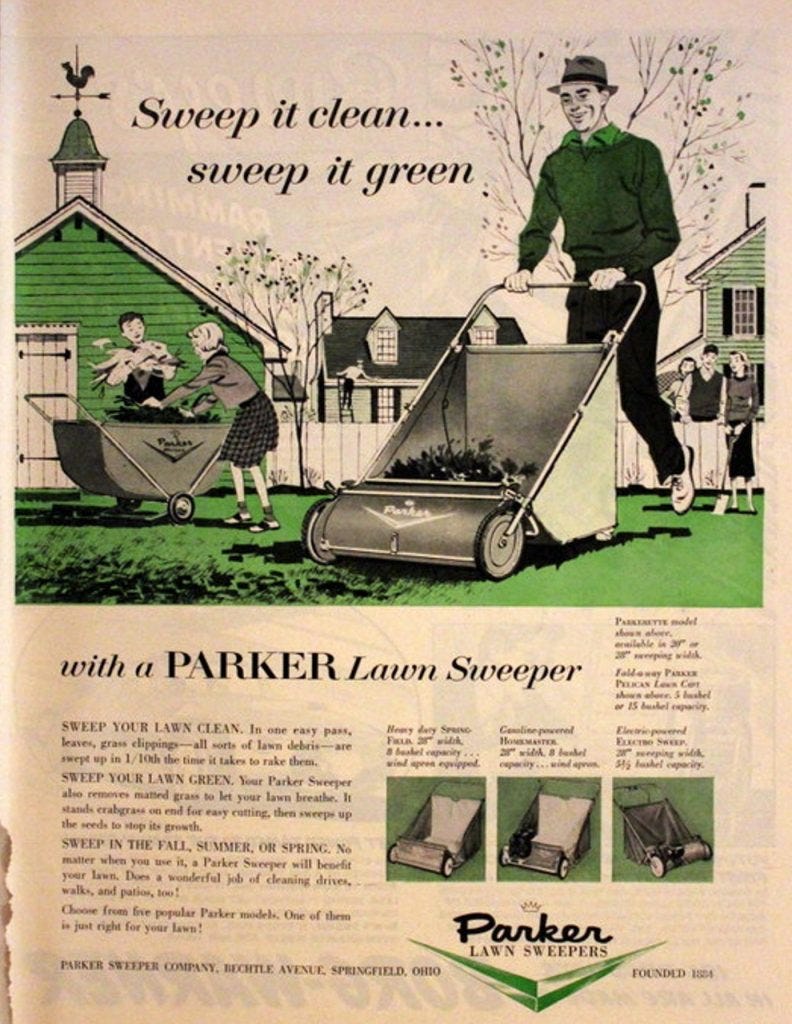
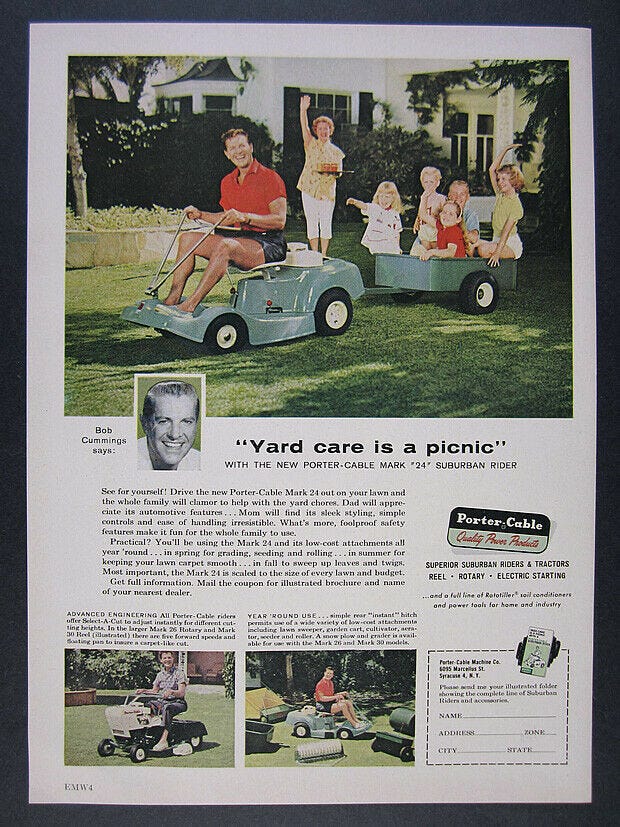
In both of these ads, the man occupies the foreground of the image actively operating lawn equipment on a large sprawling green front yard. He is the center of the image, everything in the image revolving around his presence and his work. His wife and children are positioned behind him, subordinate and supportive, enjoying the physical space his labor lawn produces. The spatial hierarchy visually communicates the roles of each family member; the man’s place is outside performing physical labor on a lawn while the woman and children’s place is closer to the home, associated with indoor responsibilities and domesticity.
Looking specifically at the Parker Lawn Sweeper ad on the left, the copy reads “Sweep it clean… sweep it green.” “Clean” carries the moral weight of purity and order while “green” evokes environmental virtue. The pairing of them suggests that lawn maintenance is about more than aesthetics; it’s about being a good, responsible man. The white picket fence in the background and well-kept home reflect that suburbia itself is the product being sold as much as the equipment.
Looking at the Porter-Cable Mark 24 Suburban Rider ad on the right, the riding mower is explicitly described as having “automotive features.” In the 1950s, the car was the primary site of masculine identity and aspiration. Thus, by associating the lawn mower with a car, the ad reframes lawn care as a domain of control, speed, and mastery, not simply a domestic chore. The man commands the machine, no longer having to push it. By doing so, he establishes himself the engine of family life literally and figuratively.
In this era, masculinity was inextricably linked to the doing of lawncare. There is visible effort as a man must lean into the machine with an engaged body. Pride came from physicality, sweat, and effort but it also came from the commanding of machinery, steering, governing, and presiding over the terrain that is a man’s lawn.
One delightful Substack article has constructed a name for the combination of lawncare and masculinity. Author Celeste Davis calls it “lawniarchy”, lawn-based masculine authority stemming from labor and care of those blades of grass.
To recap, lawn-based labor during the 1950s was proof of manhood and helped legitimize masculine authority in American culture. A man became masculine by becoming a provider, through the purchase of a house, and, importantly, the continual maintenance of a lawn. Labor made a man in this era, with the lawn as a visual receipt of accomplishment.
The logic goes like this: I work → I provide → I care (for the lawn and my family) → thus: I rule.
AMERICAN SITCOMS
I know this analysis made you deep in thought about your life in the 1950s. Maybe you were daydreaming about what it would be like to own a lawnmower and spend your afternoon engaging in physical labor to care for your manicured lawn. Maybe you pictured enjoying some cold ice tea overlooking the domain that is your (American) lawn. But alas, it’s time to move back to 2026 to examine why this mid-century framing still matters today.
2026 has been a rough year. Maybe like me, you spend time watching animated adult shows. Something about the crass humor really enables detachment from this harsh world. Well, it turns out we can take a lot from animated sitcom shows, in particular Family Guy, The Simpsons, and American Dad!. These shows truly are a reflection of our current society (and not just because of their poignant cultural references). Over the course of the past three months, I spent hours and hours watching these three shows.
You can imagine that when my parents envisioned me doing homework at university, they probably had an image of me in the library rather than eating Lesser Evil popcorn and M&Ms on the couch watching cartoons. You can also imagine how many times I was asked to put on headphones while watching (a sincere apology to my roommates).
I faced many trials and tribulations, most notably the sheer amount of Hulu advertisements I had to sit through. (I can confidently say that I have the advertisement for Skyrizi, “a solution to moderate-to-severe plaque psoriasis”, memorized). Nevertheless, I persisted. I immersed myself (and lost a few brain cells), so you do not have to, in order to tell you everything you need to know about masculinity, patriarchy, and labor.
You may ask, why animated shows? Well, aside from my desire to watch cartoons for class credit, long-running animated sitcoms are a useful lens for examining how cultural attitudes shift over time. Shows that have aired for 20-30 years reflect the anxieties, contradictions, and assumptions of the decades it passes through. Animated sitcoms operate through the medium of comedy. While watching the shows, you are not asked to think critically about why you find something funny, you simply laugh along with the laughtrack. This unreflective quality is what makes these shows valuable. Furthermore, Family Guy, The Simpsons, and American Dad! are all, importantly, shows about white, suburban, middle-class fathers, which places them in direct conversation with the postwar ideal established in the 1950s. The lawn, house, and family structure from the 1950s remain the same but how each character operates in it is what proves to be insightful. Family Guy, The Simpsons, and American Dad! demonstrate how the persistence of masculine authority in American culture has continued, even after the erosion of the 1950s ideals, which swept aside the legitimizing aspect of the lawn-based labor.
The American lawn remains a constant visual fixture in these animated shows. For example, in Family Guy, the front yard of the Griffin’s house is the first shot played after the theme song. In American Dad!, the front yard is visible in the first second of the theme song. In The Simpsons, the front yard is visible one minute and five seconds into the opening sequence. In all three instances, the lawn has a notable role in establishing shots; across all, it is seen as green, trimmed, and insistently suburban.
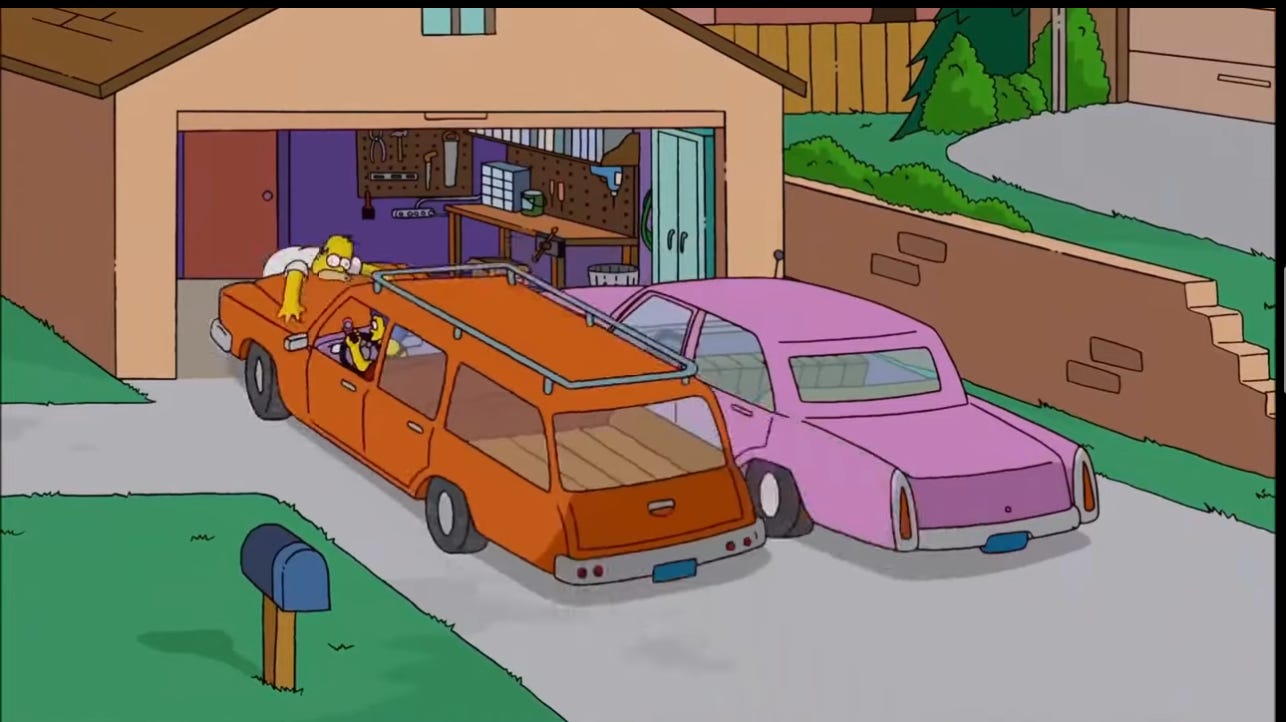
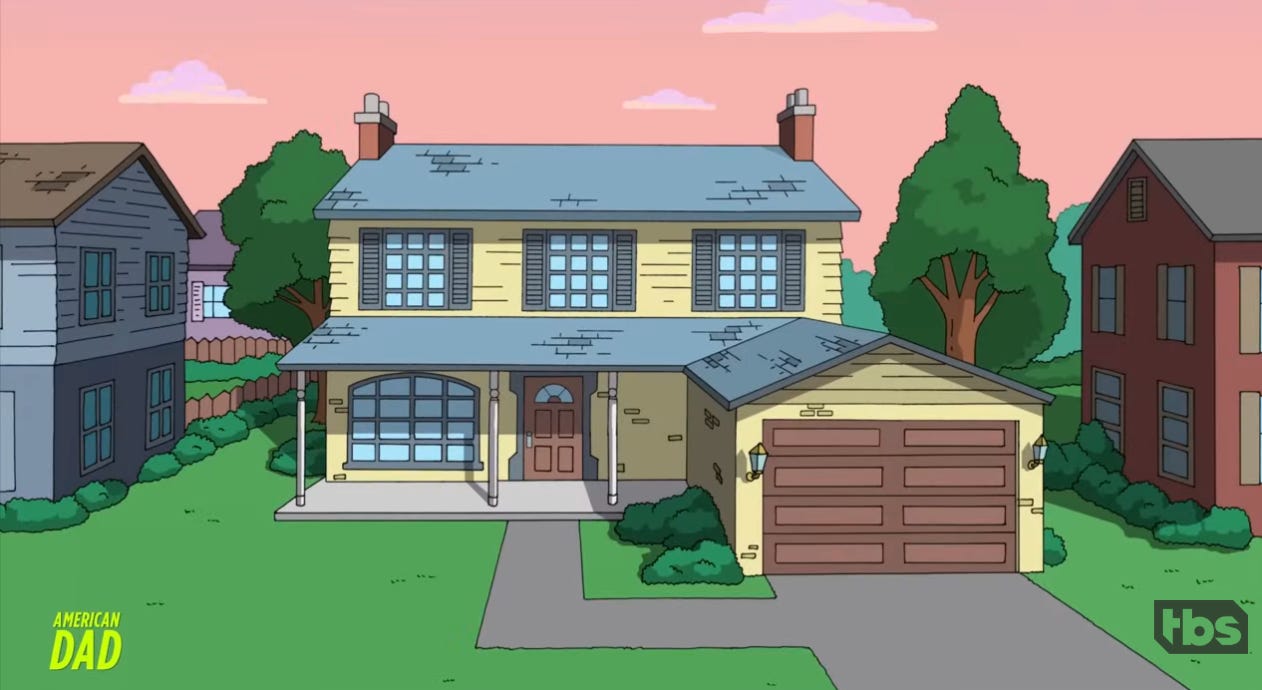
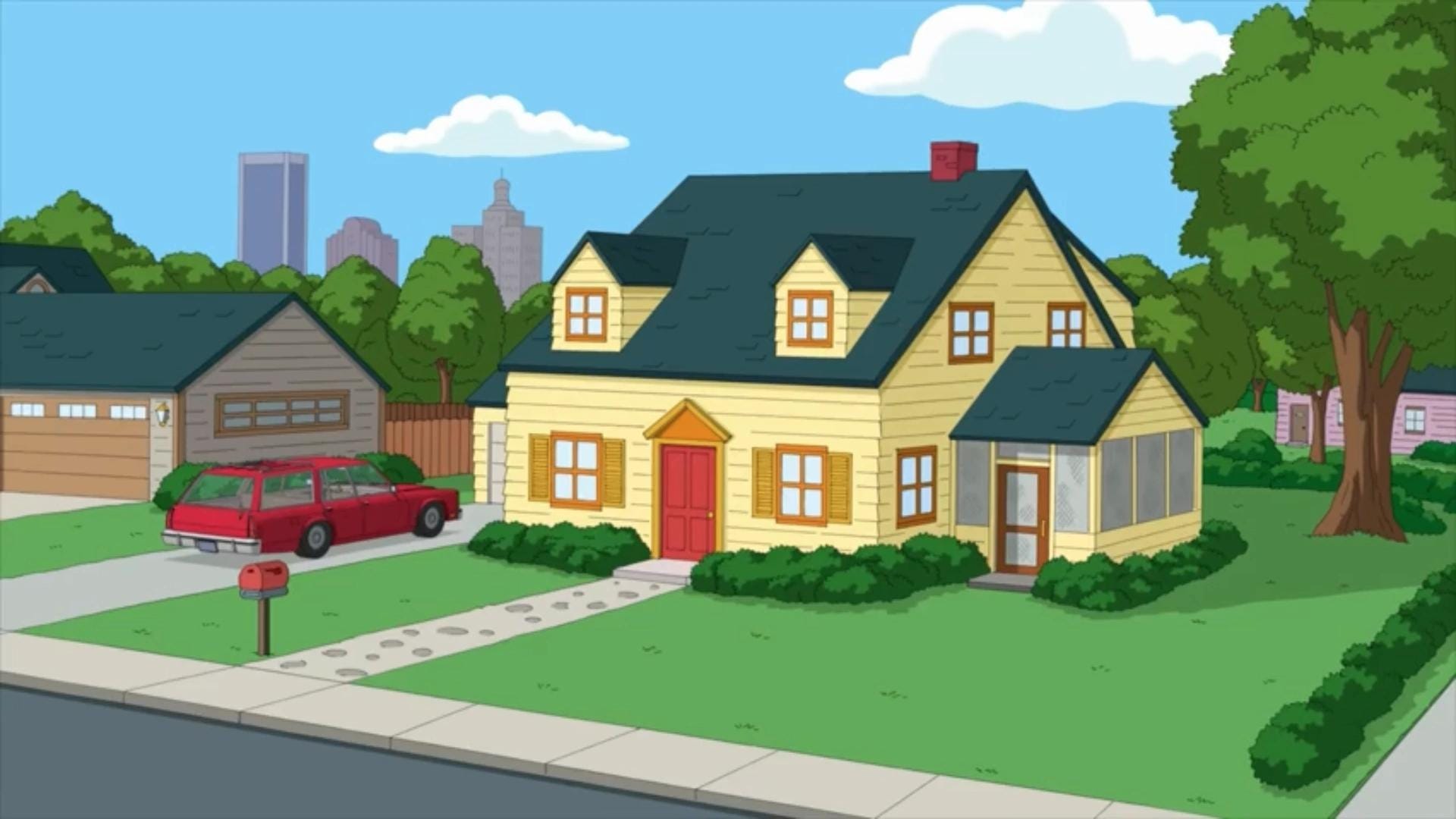
Though the cartoon lawns look eerily similar to those depicted in the 1950’s advertisements, what has changed is its relationship with the show’s male main characters. Unlike their mid-century counterparts, Peter, Homer, and Stan do not maintain the lawn; they outsource the labor, resent the expectations attached to it, ignore the lawn altogether, or obsess over it in an attempt to control their territory. In the 1950s, lawn care helped cultivate masculinity, but in these animated sitcoms, the labor dimension has disappeared.
The question then becomes if masculinity can no longer justify itself through care and labor, on what grounds does it claim authority? How are these main characters — Peter, Stan, and Homer — still able to assert themselves as the man of the house? I will argue that the abandoning of labor in lawn care creates a fragmentation of masculinity into multiple forms (ironized masculinity, residual masculinity, and proprietary masculinity) reflected in the 3 sitcoms, each preserving patriarchal position while abandoning the labor that once justified it.
Let’s begin with Family Guy. Since 1999, Family Guy has been a hit in the cartoon comedy genre. The show revolves around the Griffin family’s lives in Quahog, Rhode Island and in particular the father Peter Griffin, a straight white man simultaneously childish, vulgar, and lazy. His neighbors and friends represent a range of American stereotypes and minority groups (Danowski 22). Peter Griffin embodies a form of ironized masculinity that endures through parody rather than authority. In Family Guy, Peter Griffin represents an exaggerated extension of what Cerise L. Glenn identifies as the crisis of white masculine fatherhood, where the patriarch continues to occupy his role despite a failure to fulfill traditional expectations associated with it (Glenn 174). In the show, Peter abandons the premise of responsibility altogether, taking on the trope of the inept lazy father. For example, in Season 17, Episode 8, entitled “Con Heiress,” Peter’s wife Lowis continually asks him to mow the lawn to which he refuses. He eventually agrees to teach his son Chris how to mow it so that he does not have to; though when the two get outside, Peter places a phone in front of Chris claiming “You can watch this ‘how to’ video on YouTube.” The fact that Peter does not even teach his son how to mow the lawn but outsources it to a millennial on YouTube with blonde tips and a hippie necklace underscores how Peter has transformed masculinity into a site of mockery and irony. Peter’s relationship to domestic labor such as lawn care is defined not by failure but of open ridicule. He sees the lawn as arbitrary and meaningless rather than as a site to produce his masculinity. However, despite this shift of the ridiculing of labor, his patriarchal authority still persists. He is frequently bossing his wife Lois around, drinking beer with his friends instead of helping with the kids, and coming up with selfish ideas at the expense of those around him. Thus, his masculinity and power does not last because of strength or respect but because apathy remains a quiet assertion of power. For Peter, doing nothing and refusing to care is a means of staying in control.
While masculinity in Family Guy persists through mockery, in the case of Homer Simpson, masculinity survives through lowering the expectations of what it means to be a man. Thus, Homer embodies a residual masculinity, where competence and labor are stripped leaving behind nothing but the titles of man, father, and husband. The Simpsons emerged in the late 1980s and is the longest-running American animated series. The show has aired over 800 episodes and provides a satirical view into American culture through the lives of the Simpson family. The show’s main character, Homer is the provider of the family, holding a working-class job and a nuclear power plant. Despite his role as a provider he is immature, unintelligent, and ignorant. His diet consists of beer and donuts and often fails at his role. Unlike Peter, Homer does not reject masculinity outright; he merely fails to perform it repeatedly. He is an example of the sitcom father Glenn describes as a character who often “struggle with [their] role in the household” while still attempting to be recognized as the “man” of the family, a tension that is central to Homer’s characterization (Glenn 2012). For example, in Season 3, Episode 15, entitled “Homer Alone,” Homer’s wife, Marge, suffers from a nervous breakdown due to the overwhelming, thankless nature of household chores. Marge proceeds to leave Homer alone with the kids to go on vacation to recover, resulting in a complete inability to take care of his own children; the lawn is a visual representation of the turmoil he creates, represented as overgrown and unruly. However, despite an inability to support his family and meet traditional masculine duties, like lawncare, his authority as the father figure remains. In fact, his role as the man of the house is not questioned in 34 seasons of the show that follow. Thus, Homer does not need to prove himself through competence, labor, or responsibility to keep his place; masculinity survives even without the effort to justify it.
In American Dad!, Stan Smith represents a different post-1950s formation of masculinity than either Homer Simpson or Peter Griffin. He is not defined by comic refusal or incompetence, but by a compensatory investment in order and surveillance. American Dad! is an animated sitcom following Stan Smith, a patriotic CIA agent who attempts to use drastic authoritarian measures to create order amid the chaos of his home life. Whereas Peter ridicules domestic labor and Homer simply fails at it, Stan displaces it entirely, replacing the performance of care with the performance of control. Thus, Stan embodies proprietary masculinity: authority claimed through ownership rather than earned through effort. In the opening scene of Season 8, Episode 4, “American Stepdad” Stan is seen visually framed within the iconography of postwar masculine competence with his suburban home and a large American flag blowing in the wind behind him. However, despite the association with masculine competence, he is seen struggling to mow his lawn, with visible sweatstains and an inability to produce straight lines across the lawn. However, this failure does not diminish his authority. Instead of putting additional effort into lawn labor after failure, Stan redirects control towards the household itself: he orders Jeff to move to the basement, asserting dominance by reorganizing who occupies which spaces within the home. He is able to ignore the duties of labor and instead focus on performing control. Thus, the lawn is not a site of labor but rather an extension of the household territory Stan governs.
In each of the three new emergent forms of masculinity, the lawn is no longer in the foreground, needing to be maintained, but rather existing as a backdrop holding symbolic value without the labor and upkeep. In these versions of lawns without labor, what remains is a transformed version of masculinity, where a man’s authority is no longer earned through visible labor and effort but pre-installed as he continues to occupy the symbolic position of patriarch in a more passive way (whether through mockery, failure, or authority). Despite the change in labor, the lawn continues to signal moral order and respectability. The man can still claim that he is a good citizen and patriotic father with a moral home despite the fact that he now occupies the role of head of household from the onset, not performing it into existence but taking it for granted.
CONCLUSION
This article argues (that watching cartoons for class is a worthwhile endeavor) that animated sitcoms can serve as a vehicle for studying the transformation of masculinity in American life. Through characters like Peter Griffin, Homer Simpson, and Stan Smith, these shows trace a shift away from a model of masculinity grounded in visible labor, like in the 1950s, and towards one sustained through presupposed entitlement and authority. The suburban lawn, once a site where masculine identity was produced, now operates only as a symbolic background. If masculine power no longer needs to be earned through labor, then what happens to the logic of patriarchy?
Sources
Danowski, Justin. “Hegemonic Peter?: A Critical Analysis of Hegemonic Masculinity in Family
Guy.” Master’s Theses, no. 759, 2012, Eastern Illinois University, https://thekeep.eiu.edu/theses/759.
Glenn, Cerise L. White Masculinity and the TV Sitcom Dad: Tracing the “Progression” of
Portrayals of Fatherhood.
“The Evolution of American Family Structure.” Concordia University, St. Paul,
https://online.csp.edu/resources/article/the-evolution-of-american-family-structure/.